Introduction
Almost every application you use today relies on APIs. Whether you are ordering food, booking a flight, chatting with an AI assistant, or checking your bank balance, APIs are working behind the scenes to connect systems and exchange information.
Among all API architectures, REST API has become the most widely adopted standard in modern software development.
Its simplicity, scalability, and compatibility with web technologies have made it the foundation of countless applications, platforms, and digital services.
What is a REST API?
REST stands for Representational State Transfer.
It is an architectural style that allows applications to communicate over HTTP using standardized methods.
A REST API exposes resources through URLs and allows clients to interact with those resources using HTTP requests.
For example:
GET /users/123
may retrieve information about a specific user.
POST /orders
may create a new order.
REST provides a simple and predictable way for applications to exchange data regardless of the programming language or platform being used.
How REST APIs Work
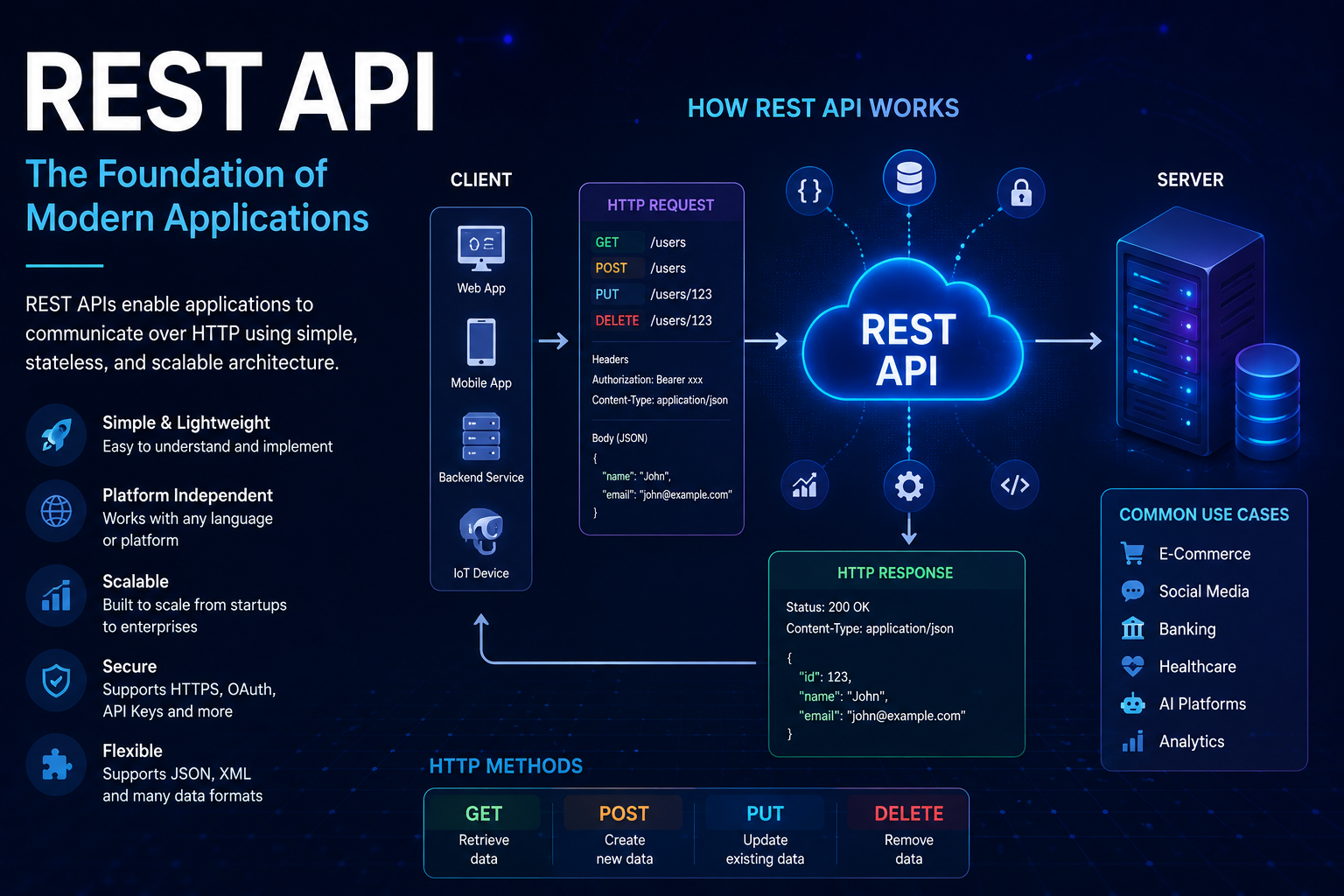
REST APIs operate using a request-response model.
Client
The client initiates a request.
Examples include:
- Mobile applications
- Websites
- Backend services
- IoT devices
Server
The server processes the request and returns a response.
Response
Responses typically contain:
- Status code
- Headers
- Data payload
Most modern REST APIs use JSON as the primary data format.
HTTP Methods in REST
REST APIs commonly use four primary HTTP methods.
GET
Retrieves data.
Example:
Get user information.
POST
Creates new data.
Example:
Create a new customer.
PUT
Updates existing data.
Example:
Update user profile information.
DELETE
Removes data.
Example:
Delete a record.
These methods create a predictable and standardized interface for developers.
Why REST Became So Popular
REST gained widespread adoption because it is:
Simple
Easy to understand and implement.
Language Independent
Works with virtually any programming language.
Scalable
Supports applications ranging from startups to global enterprises.
Lightweight
Consumes fewer resources compared to older architectures.
Web Friendly
Built directly on top of HTTP.
Real-World Examples
REST APIs power many services we use daily.
Examples include:
Social Media Platforms
- User profiles
- Posts
- Comments
- Followers
E-Commerce Platforms
- Products
- Orders
- Payments
- Inventory
AI Platforms
- Text generation
- Image generation
- Speech processing
Banking Applications
- Account information
- Transactions
- Payment processing
Advantages of REST APIs
Fast Development
Developers can build integrations quickly.
Large Ecosystem
Supported by nearly every programming language and framework.
Easy Integration
Third-party services often provide REST APIs by default.
Scalability
Supports millions of requests efficiently.
Flexibility
Can serve web, mobile, desktop, and server applications simultaneously.
Limitations of REST APIs
Despite their popularity, REST APIs are not perfect.
Common challenges include:
Over-Fetching
Clients may receive more data than required.
Under-Fetching
Multiple requests may be required to gather related information.
Multiple Round Trips
Complex applications often require many API calls.
Real-Time Limitations
REST is request-response based and is not ideal for real-time communication.
These limitations led to the development of alternatives such as GraphQL, WebSockets, and gRPC.
REST vs Other API Technologies
REST vs WebSocket
REST is ideal for standard request-response communication.
WebSocket is better for real-time applications such as chat platforms and live dashboards.
REST vs GraphQL
REST exposes predefined endpoints.
GraphQL allows clients to request exactly the data they need.
REST vs gRPC
REST is easier to use and more universally supported.
gRPC offers significantly higher performance for internal services.
Best Practices
Organizations should follow several best practices when building REST APIs.
Use Consistent Naming
Example:
/users
/orders
/products
Version APIs
Example:
/api/v1/users
Secure Endpoints
Use:
- HTTPS
- OAuth
- JWT
- API Keys
Return Meaningful Status Codes
Examples:
200 OK
201 Created
400 Bad Request
404 Not Found
500 Internal Server Error
Provide Documentation
Good documentation dramatically improves developer experience.
The Future of REST APIs
Despite the emergence of newer technologies, REST remains the dominant API architecture across the industry.
Most SaaS platforms, cloud services, fintech products, healthcare applications, and AI providers continue to rely heavily on REST APIs.
For developers, understanding REST is often the first and most important step toward mastering modern software integration.
Even as GraphQL, WebSockets, and AI-powered systems continue to grow, REST APIs will remain a critical component of software architecture for years to come.