Introduction
Artificial Intelligence is no longer limited to large technology companies with massive engineering teams and research budgets. Today, startups, SMEs, and enterprises can integrate advanced AI capabilities into their products within days rather than years.
The key enabler behind this transformation is the AI API.
Instead of building and training complex machine learning models from scratch, companies can access state-of-the-art AI models through APIs and immediately add intelligent capabilities to their applications.
Whether it’s generating text, creating images, analyzing documents, transcribing audio, or building AI agents, APIs have become the foundation of modern AI products.
What is an AI API?
An AI API (Application Programming Interface) is a service that allows applications to communicate with artificial intelligence models through simple requests.
Rather than developing, training, hosting, and maintaining large AI models internally, developers send requests to a provider’s API and receive AI-generated responses.
Think of an AI API as electricity.
Most businesses don’t build power plants—they connect to the electrical grid.
Similarly, companies no longer need to build their own AI infrastructure; they connect to AI providers and consume intelligence as a service.

Why Businesses Use AI APIs
Building AI systems internally requires:
- Machine learning expertise
- Large datasets
- Expensive GPU infrastructure
- Continuous model maintenance
- Ongoing research and optimization
AI APIs eliminate these barriers.
Benefits include:
Faster Time-to-Market
Products can launch in weeks instead of months.
Lower Development Costs
No need for expensive AI infrastructure.
Access to State-of-the-Art Models
Companies can leverage the latest AI advancements immediately.
Scalability
Most AI providers automatically scale based on demand.
Reduced Technical Complexity
Developers can focus on solving business problems rather than managing AI infrastructure.
Common Types of AI APIs
Text Generation APIs
These APIs generate human-like text.
Use cases include:
- Chatbots
- Customer support
- Content creation
- Knowledge assistants
- Email generation
- Product descriptions
Examples:
- GPT models
- Claude
- Gemini
- DeepSeek
Image Generation APIs
These APIs create images from text prompts.
Use cases include:
- Marketing assets
- Product visuals
- Social media content
- Advertising campaigns
- Creative design
Businesses can generate high-quality visuals without traditional design workflows.
Speech-to-Text APIs
Convert spoken language into text.
Applications include:
- Call center analysis
- Meeting transcription
- Voice assistants
- Medical documentation
Text-to-Speech APIs
Convert text into natural-sounding speech.
Applications include:
- Audiobooks
- Virtual assistants
- Accessibility solutions
- Interactive learning platforms
Vision APIs
Analyze images and videos.
Applications include:
- OCR
- Medical imaging
- Quality control
- Identity verification
- Object recognition
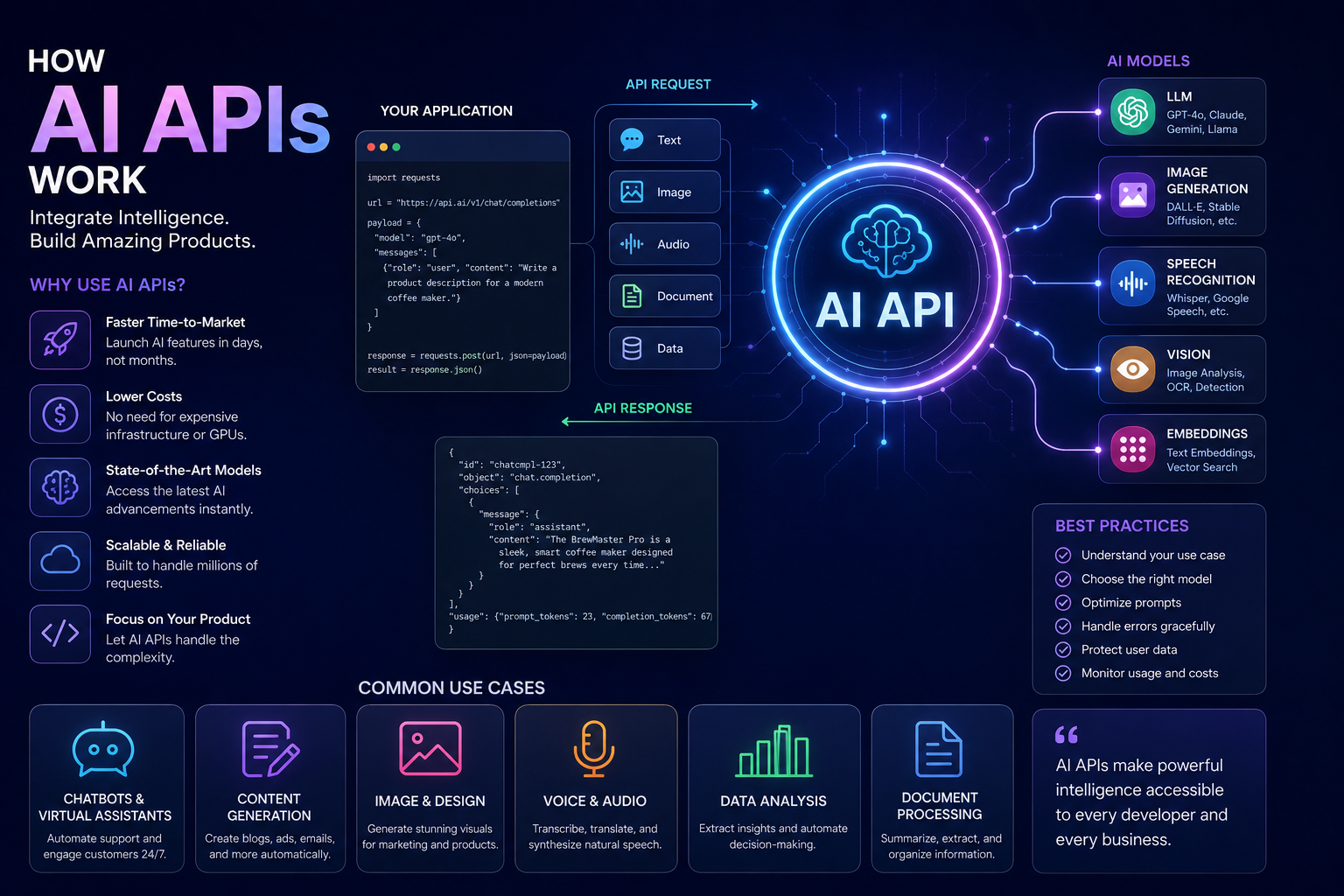
How AI APIs Work
Most AI APIs follow a simple process:
Step 1: Send a Request
Your application sends data to the API.
Examples:
- Text prompt
- Image
- Audio file
- Document
Step 2: AI Processing
The model processes the request using advanced neural networks.
Step 3: Receive a Response
The API returns structured output.
Examples:
- Generated text
- Image
- Classification result
- Summary
- Translation
The entire process often takes only a few seconds.
Real-World Applications
Customer Support
AI APIs can:
- Answer customer questions
- Summarize conversations
- Classify support tickets
- Provide multilingual support
This reduces support costs while improving response times.
Healthcare Platforms
Healthcare startups use AI APIs for:
- Medical report analysis
- Health recommendations
- Patient engagement
- Risk assessment
- Clinical documentation
For health-tech startups, AI APIs enable advanced features without requiring large internal AI teams.
E-Commerce
AI APIs help online stores:
- Generate product descriptions
- Recommend products
- Improve search experiences
- Analyze customer sentiment
- Automate customer support
SaaS Platforms
Software companies use AI APIs to:
- Create AI assistants
- Automate workflows
- Analyze user behavior
- Generate insights
- Improve productivity
AI APIs and Startups
Startups benefit more than almost any other type of business.
Instead of spending hundreds of thousands of dollars building AI infrastructure, a startup can:
- Connect to an AI API
- Pay only for usage
- Launch quickly
- Validate market demand
- Scale gradually
This dramatically reduces risk while accelerating innovation.
Many successful AI startups today are built primarily on top of existing AI APIs.
Challenges and Considerations
Despite their advantages, AI APIs require careful planning.
Organizations should consider:
Cost Management
High-volume usage can become expensive if not optimized.
Data Privacy
Sensitive information must be handled securely.
Vendor Dependency
Products may become dependent on external providers.
Response Quality
AI outputs should always be validated before use in critical applications.
Compliance
Businesses must ensure compliance with local regulations and industry standards.
AI APIs vs Building Your Own Models
For most companies, APIs are the better choice.
Building custom models only makes sense when:
- You have proprietary datasets
- You require complete control
- You operate at massive scale
- Your use case is highly specialized
For the majority of startups and businesses, APIs provide faster deployment, lower costs, and better results.
The Future of AI APIs
AI APIs are rapidly becoming the digital infrastructure of modern software.
Just as cloud computing transformed how applications are built, AI APIs are transforming how intelligence is integrated into products.
Future applications will increasingly rely on AI APIs for:
- Autonomous agents
- Intelligent automation
- Personalized experiences
- Predictive decision-making
- Advanced content generation
Organizations that adopt AI APIs today will be better positioned to innovate, compete, and scale in an AI-driven economy.
The future of software is not just software—it is software powered by artificial intelligence.